You notice it on the drive home first.
The lane lines seem dimmer than they used to. Street signs don't pop until you're closer. In Lincoln, that gets old fast when you're driving after work, heading across town for practice pickup, or coming back on a cold evening with glare bouncing off every windshield. A lot of drivers assume their bulbs are getting weak, but many times the problem is sitting right in front of them: the plastic headlight lens has gone cloudy, yellow, or chalky.
That kind of haze doesn't just make a vehicle look older. It cuts down the amount of usable light reaching the road. A good car headlight restoration service fixes the damaged outer layer, brings the lens back to clarity, and protects it so it doesn't turn dull again right away. Done correctly, it's one of the most practical detail services you can buy because it improves safety and appearance at the same time.
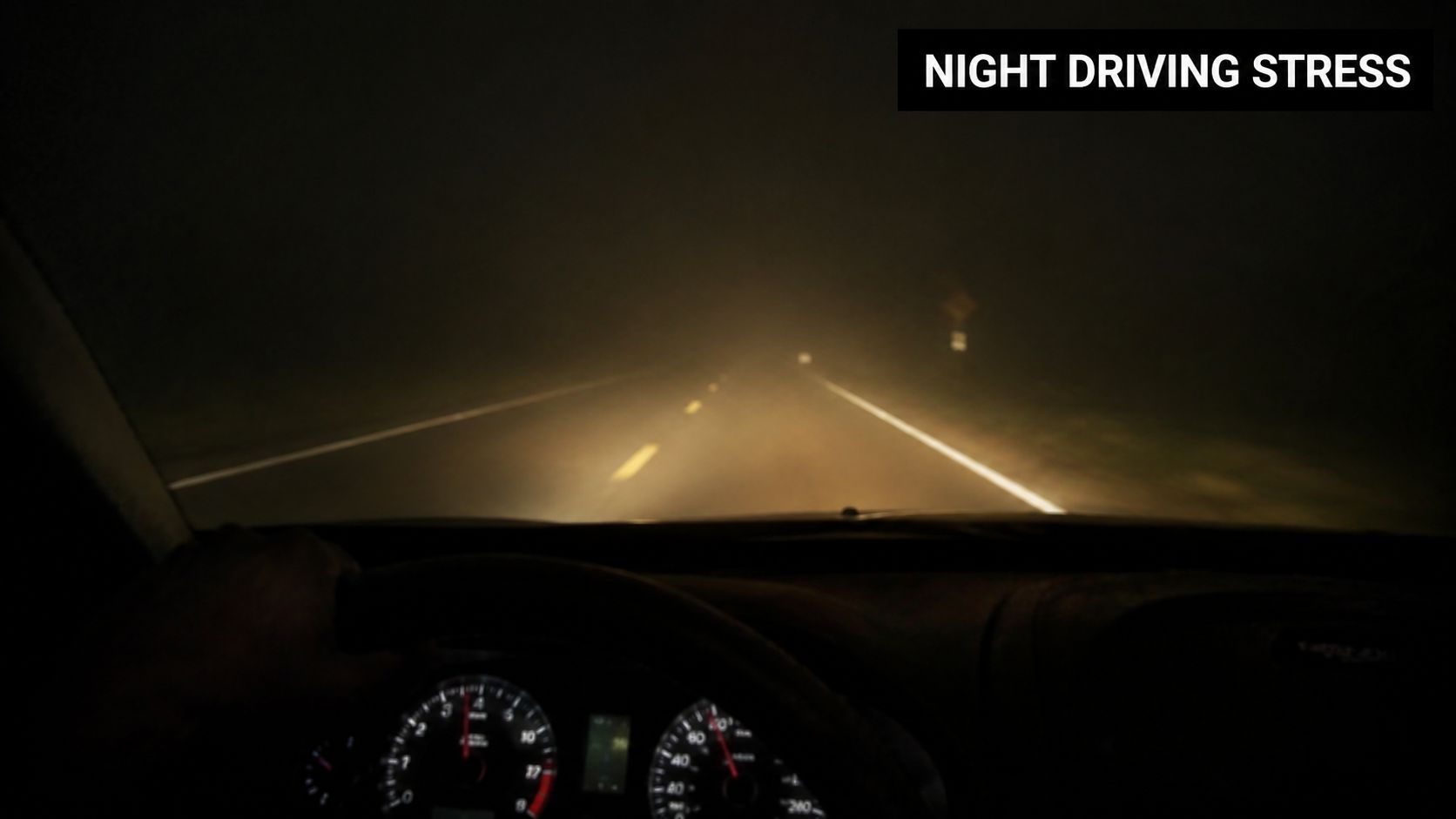
Is Night Driving More Stressful Than It Used to Be
A lot of people don't realize how gradually bad headlights sneak up on them. At first, the car still looks fine from a distance. Then one evening you're driving west across Lincoln after sunset and find yourself leaning forward a little more than usual, trying to make out the edge of the road. Oncoming drivers seem harsher. Rain makes everything worse. You start wondering if your eyes are the issue.
Most of the time, the first clue is visible in daylight. The lens looks yellowed, milky, or patchy. You may even see a rough, dry-looking surface when the sun hits it. That outer layer has taken years of UV exposure, weather, road grime, and washing. What used to be clear plastic now scatters light instead of letting it pass cleanly through.
What drivers usually notice first
Night visibility problems often show up as small frustrations before they feel like a real safety issue.
- Faded beam pattern: The road ahead looks dull even though the headlights are on.
- More strain: You squint more, especially on unlit roads or in bad weather.
- More glare: Hazy lenses can throw light unevenly, which makes driving feel less controlled.
- An older appearance: Even a clean vehicle can look neglected with cloudy headlights.
If your headlights look foggy in daylight and weak at night, the lens condition is worth checking before you replace bulbs.
The good news is that many headlights don't need replacement. If the damage is on the outside surface, restoration can remove that oxidized layer and bring the lens back to a much clearer finish. That makes night driving feel more normal again. Less guessing. Less strain. More confidence behind the wheel.
The Triple Benefit of Headlight Restoration
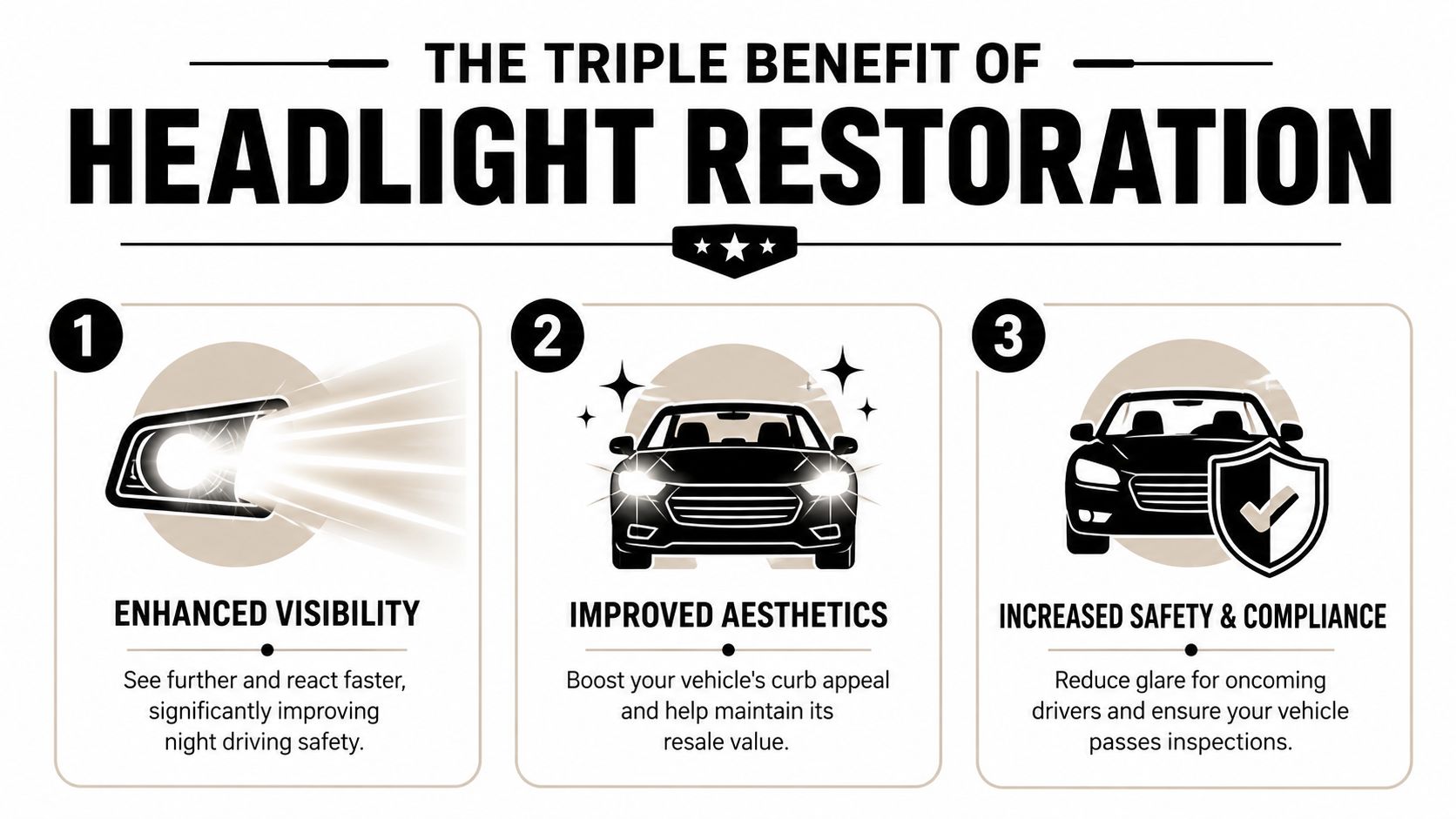
Headlight restoration isn't just about making a car look cleaner. It solves three separate problems at once: visibility, appearance, and value.
Safety comes first
This is the biggest reason to take cloudy headlights seriously. Research cited by AAA found that deteriorated headlights can reduce a driver's visibility by 80% and produce only 22% of the light output compared to functional headlights, as noted in AAA-cited headlight restoration safety findings.
That lines up with what detailers see in practice. A lens can still let some light through and still be performing badly. Drivers often adapt without realizing it. They slow down more, avoid dark roads, or just accept that night driving feels harder than it should.
A cleaner front end changes the whole car
Cloudy headlights age a vehicle fast. It doesn't matter if the paint is washed and the interior is spotless. If the lenses are yellow and dull, the whole front end looks tired.
Restored headlights sharpen the face of the vehicle right away. The change is especially noticeable on silver, white, black, and red vehicles because the contrast makes the haze stand out. That's one reason detailers often recommend restoring headlights alongside exterior detailing. If you're comparing services, this overview of why headlight restoration matters for safety and appearance gives a good summary of that combination.
Practical rule: If the headlights are the first thing your eye lands on when you look at the front of the car, they're probably pulling the whole vehicle down visually.
Value isn't just resale
People hear "value" and think only about selling the car. That's part of it, but not all of it. Value also means getting more usable life out of what you already own.
A headlight restoration service helps in a few ways:
- Daily driving value: You get a vehicle that's easier to drive at night.
- Appearance value: The car looks better without replacing the assemblies.
- Maintenance value: You address oxidation before it turns into a bigger frustration.
- Buyer impression: Cleaner headlights make a used vehicle look more cared for.
For many owners, that's enough to make restoration an easy call. It's one of those services where the benefit is visible immediately, but the bigger payoff is how the car feels afterward.
What Professionals Do to Restore Headlight Clarity
A proper restoration is a lot like skincare for your car. You don't fix damaged skin by wiping on one product and hoping for the best. You clean it, remove the dead layer evenly, refine the surface, and protect it. Headlights work the same way.
The work starts before sanding
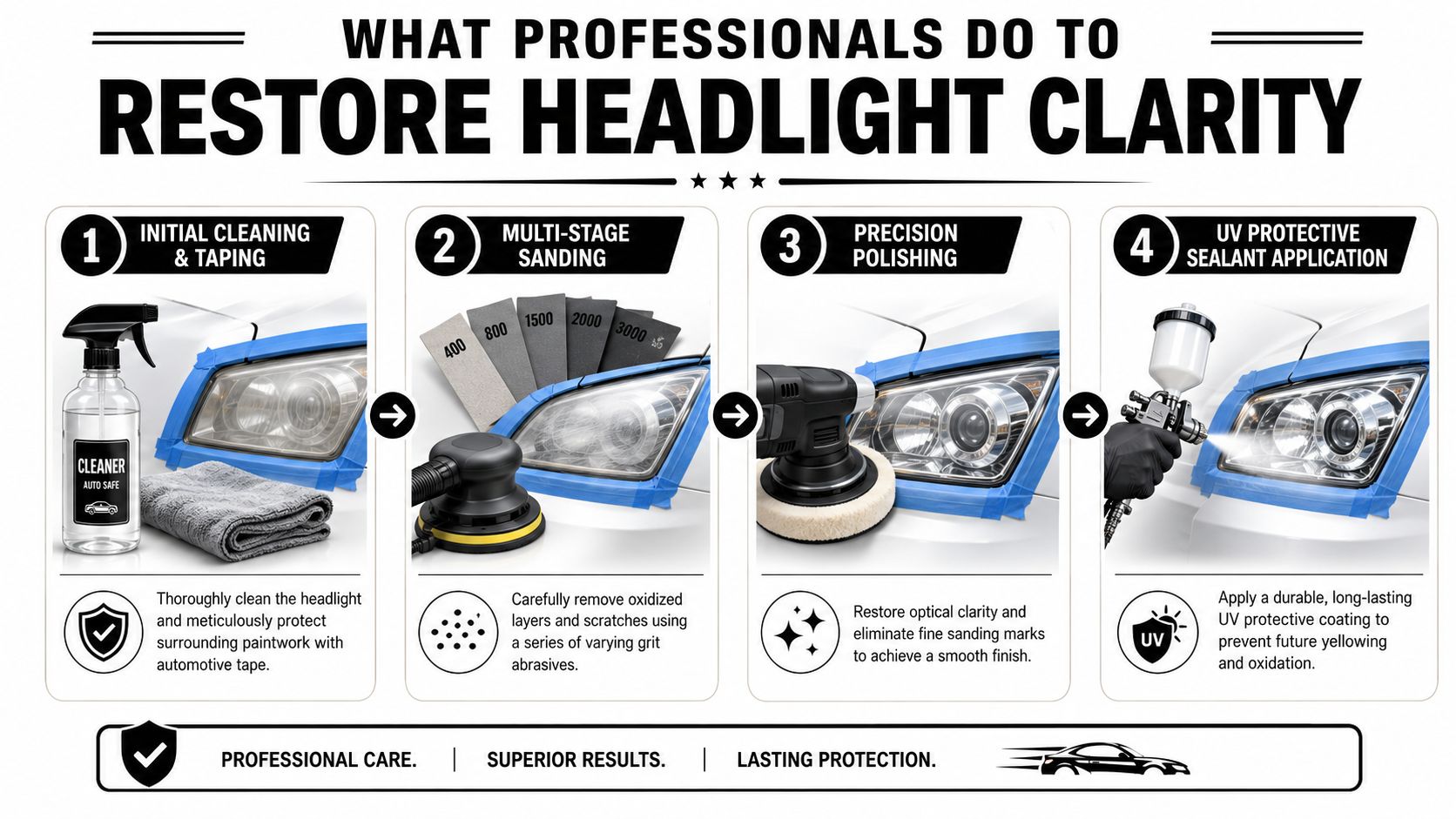
A professional doesn't jump straight to abrasives. First comes inspection, cleaning, and masking. The lens has to be clean enough to see what the actual damage looks like, and the surrounding paint and trim need protection.
Tape matters here. So does patience. Sloppy edge work is one of the easiest ways to leave accidental marks on bumper paint or trim pieces around the headlight housing.
Sanding removes the failed surface
The key step is wet sanding. According to Detailed Image's headlight restoration process guide, a professional headlight restoration service uses a progressive grit sequence, typically 600, 800, 1500, and 2000 grit, followed by machine polishing to remove sanding haze and restore optical clarity.
That sequence matters because each grit removes the marks from the step before it. Skip a stage or rush one side and the lens can look clearer at first but still carry deep scratches, uneven patches, or distortion when light shines through it.
A typical professional process looks like this:
- Clean and inspect the lens so the technician can see oxidation, pitting, or prior failed repair work.
- Mask surrounding paint and trim to protect the vehicle during sanding and polishing.
- Wet sand in stages using progressively finer grits.
- Machine compound and polish to remove haze and bring the surface back to transparency.
- Apply a protective finish to help defend the fresh surface from UV damage.
Polishing is where clarity comes back
After sanding, the lens usually looks uniformly dull. That's normal. The sanding has leveled the damaged surface, but it hasn't restored transparency yet.
Machine polishing refines that sanded plastic and removes the fine haze left behind. Here, professional tools make a real difference. A consistent machine polish tends to produce a more even finish than hand polishing, especially around curves and edges. If you want to see the kind of transformation this process can produce, these headlight restoration before and after examples show what restored clarity looks like on real vehicles.
The sanding removes the problem. The polishing reveals the result.
Protection is what makes the work worth it
Freshly corrected polycarbonate needs protection. Without it, the lens is exposed again and can start degrading sooner than you'd want. That's why a professional service doesn't stop once the headlight looks clear.
This last step often gets treated like an extra, but it isn't. It's part of the repair. A headlight that has been sanded and polished needs a proper UV-resistant finish if you want the clarity to hold up.
DIY Headlight Kits vs A Professional Service
DIY kits exist for a reason. Some of them can improve lightly oxidized headlights, especially when the damage is clearly on the exterior and the owner follows the directions carefully. If your lens has mild haze and you like doing your own car care, a kit can be a reasonable starting point.
Where things usually go sideways is durability, diagnosis, and finish quality.
DIY can work, but conditions matter
The most overlooked part of a DIY job isn't the sanding. It's the coating step afterward. According to Delta Kits' headlight restoration application guidance, ideal application requires 50°F to 100°F indoors, and water exposure before the coating is fully dry can cause cloudiness.
That's a big deal in Nebraska. Plenty of people apply a kit in a driveway, a breezy garage, or a cold snap, then assume the product failed. Sometimes the product was fine. The environment wasn't.
The biggest DIY mistake isn't sanding
A lot of drivers buy a kit without confirming what kind of damage they have. If the cloudiness is inside the housing, exterior restoration won't solve it. That's one reason professional inspection matters more than most guides admit.
Another problem is uneven sanding pressure. It doesn't take much to leave patchiness, edge marks, or a lens that looks better from ten feet away but not up close.
Side by side comparison
| Factor | DIY Kit | Professional Service (like GP Mobile) |
|---|---|---|
| Assessment | You diagnose it yourself | Technician can inspect the lens condition before starting |
| Surface correction | Usually limited by consumer tools and user experience | Multi-step correction with professional process and equipment |
| Finish quality | Can improve appearance, but may look uneven | Typically more uniform clarity across the full lens |
| Coating conditions | Hard to control temperature, moisture, and dust | Better control over application environment |
| Risk | Easier to sand unevenly or leave marks | Lower chance of user error when performed properly |
| Best use case | Mild exterior haze and careful owners | Moderate to heavy exterior oxidation, or when you want predictable results |
If you're weighing providers, looking through actual customer feedback helps. A page with headlight restoration reviews from local customers is often more useful than polished marketing copy because you can spot patterns in how a shop communicates and what results people mention.
Worth knowing: The sealant step is where many DIY jobs lose longevity, not the initial visual improvement.
When DIY makes sense and when it doesn't
DIY is a fair option when:
- The damage is light: The lens has mild haze, not deep yellowing or obvious surface wear.
- You have the right space: Indoors, clean, dry, and within the recommended temperature range.
- You don't mind risk: You're comfortable taping, sanding, and refining plastic surfaces carefully.
A professional service makes more sense when:
- The headlights are heavily oxidized
- You want a more consistent finish
- You don't have a controlled place to apply the coating
- You want someone to check whether restoration is even the correct fix
That's the honest trade-off. DIY can be cheaper up front. Professional work is usually more predictable, especially when the lenses are already far gone.
What to Expect for Cost and Time
Most drivers don't want surprises here. They want to know whether a headlight restoration service is affordable, and whether it will eat up half the day.
According to Thumbtack's 2026 mobile headlight restoration cost data, the national average cost for mobile headlight restoration typically ranges from $153 to $267 per vehicle. Simpler jobs can come in lower, while more difficult restorations can cost more depending on the vehicle and the condition of the headlights.
Why pricing varies
The price isn't random. It usually reflects how much correction work the lens needs and how involved the process will be.
A technician may be dealing with:
- Light oxidation: Easier correction and less aggressive sanding
- Heavy yellowing: More time spent leveling the failed outer layer
- Pitting or prior bad repairs: More refinement needed to get the lens looking even
- Vehicle-specific access: Some shapes are more awkward to work on cleanly
What the appointment feels like
Convenience is frequently the primary concern. That's why mobile service is appealing. The work can often be done while you're at home or at work instead of requiring you to sit around a waiting area. Drop-off can also make sense if you want the vehicle worked on in a shop setting.
Time depends on the severity of the oxidation and the process being used, but headlight restoration is generally a short service compared with larger detail packages. It isn't an all-day paint correction job. It's targeted work on one problem area, with a noticeable payoff when it's done right.
The key is to think in terms of value, not just price. You're paying for diagnosis, material removal done carefully, surface refinement, and protection. That's different from a quick wipe-on product that changes the appearance for a short time.
How to Choose a Restoration Service in Lincoln
A good shop in Lincoln should start with diagnosis, not a sales pitch. Some cloudy headlights can be restored well. Some need replacement because the problem is inside the housing, the lens is badly cracked, or the damage has gone too far.
The biggest distinction many drivers miss is external oxidation versus internal damage. External oxidation shows up on the outer surface and can usually be corrected with proper sanding, polishing, and protection. Internal haze, peeling inside the lens, or moisture-related staining will not be fixed by restoring the outside. If a provider cannot explain that clearly, keep looking.
A solid inspection should also cover how the headlights failed in the first place. In Nebraska, sun exposure, winter grime, road salt, and big temperature swings all wear on plastic lenses and on whatever protection gets applied afterward. That matters because longevity depends on more than how clear the lens looks when the job is finished. It also depends on what sealant or coating is used, and whether it is applied under the right conditions.
What to look for before booking
Before you schedule, ask a few direct questions and pay attention to how direct the answers are.
- Do they inspect for internal damage first? A trustworthy provider will tell you if restoration is the wrong fix.
- Can they explain the process in plain language? You want to hear surface prep, sanding if needed, polishing, and a form of UV protection.
- What protection are they using afterward? This part has a big effect on durability.
- Do they mention weather and application conditions? DIY products and even some shop products can fail early if they are applied in poor temperature or humidity conditions.
- Will they set realistic expectations? Deep pitting, heavy cracking, and neglected lenses may improve a lot without looking brand new.
- Are they insured and careful around paint and trim? That is basic professionalism.
That last point gets overlooked. Headlight restoration is localized work, but it still happens right next to painted panels, rubber seals, and textured trim.
A short walkaround video can also help you understand what proper restoration involves:
What separates a careful service from a quick cosmetic fix
Some providers clear up headlights for the day. Better ones restore the surface and protect it so the result holds up.
In practice, that means looking for someone who does more than a fast polish. Polishing alone can make a lens look better briefly, but if the failed outer layer is still there, the haze comes back fast. A proper service matches the correction method to the lens condition and then seals the fresh surface with protection that can handle UV exposure. The application environment matters too. Dust, heat, cold, and humidity can all affect how well a coating or sealant cures, which is one reason professional results usually outlast a driveway kit.
Small habits that help restored headlights last
Once the headlights are corrected, a few habits help the finish hold up longer:
- Wash them gently: Regular washing is enough. Aggressive scrubbing wears on the protective layer.
- Clean off bug residue early: Bugs and road film get harder to remove after they bake in the sun.
- Park under cover when you can: Less UV exposure helps any plastic lens stay clearer longer.
- Address fresh haze early: Light oxidation is easier and cheaper to correct than heavy failure.
If you're local and want the lenses inspected before spending money on the wrong fix, GP Mobile Car Wash & Detail offers headlight restoration as part of its detailing services in Lincoln with mobile and shop options.